In this issue:
Imagine sitting in the living room of a home observing the various objects in it. As we observe them, our consciousness reaches out to them and perceives them as separate from ourselves. We categorize them, analyze them: that chair is really grubby; that statue is lovely; that cat is obnoxious…. Our impressions and judgments happen so swiftly and automatically—and can be so subtle—that it seems we have no control over them. Their source includes conditioning by family and culture, past experiences in this life, and the karmic habit energy carried over from past existences. Even if an object is experienced as neutral, it is still perceived as separate from us.
To ourselves, our reactions are obviously “right ” and “correct.” The fallacy in this attitude is that it is self-centered and ego-driven. What we see as a grubby chair another might see as a precious heirloom that grandma rocked her babies in; or see the cat’s antics as hilarious and not obnoxious; or see that lovely statue as a symbol of a religion that alienates or frightens them. Neither we, nor they, see the objects in themselves just as they are, unstained by our judgments of them.
This constant dividing of the world into separate objects and beings and then qualifying them—this incessant dualistic thinking—is mentally and spiritually exhausting.
Now imagine sitting quietly in the room in the evening before sunset. As the light dims the objects in the room begin to fade and become less distinct. The edges soften, and the boundaries between objects slowly dissolve and merge. Not being continually drawn to reach out to external things, our mind relaxes. The objects that stood out in separate individuality resolve into “undifferentiated oneness.” The darkness absorbs all that was materially manifest in the light, yet it is not altered by them. The objects have not disappeared, only our perception of them no longer reaches out to grasp after them or push them away. Whatever our egocentric, reactionary mind projected on the objects no longer applies. The darkness itself is not an object of our perception and so is not subject to our karmically influenced projections. It just is.
If we sit through the night until dawn, as the light in the room brightens the objects slowly emerge in their distinct physical individuality. Yet, because we have sat still with their oneness, as they slowly emerge into the growing light we retain the sense that the qualitative boundaries between them is the arbitrary effect of our reactionary perceptions of them. We are less inclined to project ego-induced qualities upon them but instead appreciate them for their very uniqueness as they are in themselves—“perfect, just as they are.”1The sense of the unifying, all-encompassing force of the darkness is retained even as each object has its own function. The objects come and go according to changing conditions, while the distinguishing light and unifying darkness, in themselves, abide in relation with each other.
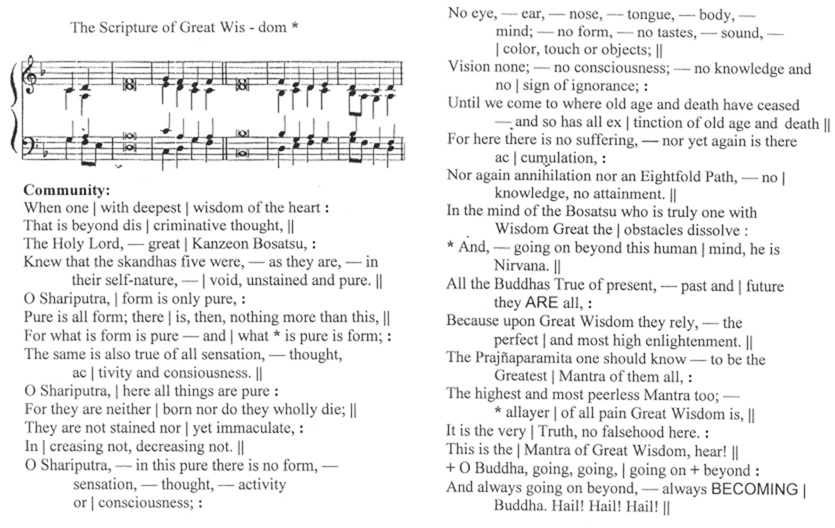
The preceding narrative is a metaphor for the relationship of the “all is One and the all is different.” In sitting still in silent meditation we open our heart-mind to experiencing the immaculacy of no-thingness. Our meditation becomes a luminous, “bright darkness” —an awareness that embraces and absorbs without aversion or attachment all that arises in our consciousness. It is, in Itself, “void, unstained, and pure.”2This experience changes us. As we go about our day we are viscerally more inclined to respond to circumstances from a place of wisdom, compassion, equanimity, acceptance and less with a judgmental and dualistic mind.

Note: the footnote references in the text link to these footnotes. To return to the text, use the Back arrow or button on your browser.
1From Most Excellent Mirror—Samadhi
2From The Scripture of Great Wisdom